(+035) 527-1710-70
 google@gmail.com
 Choose an address


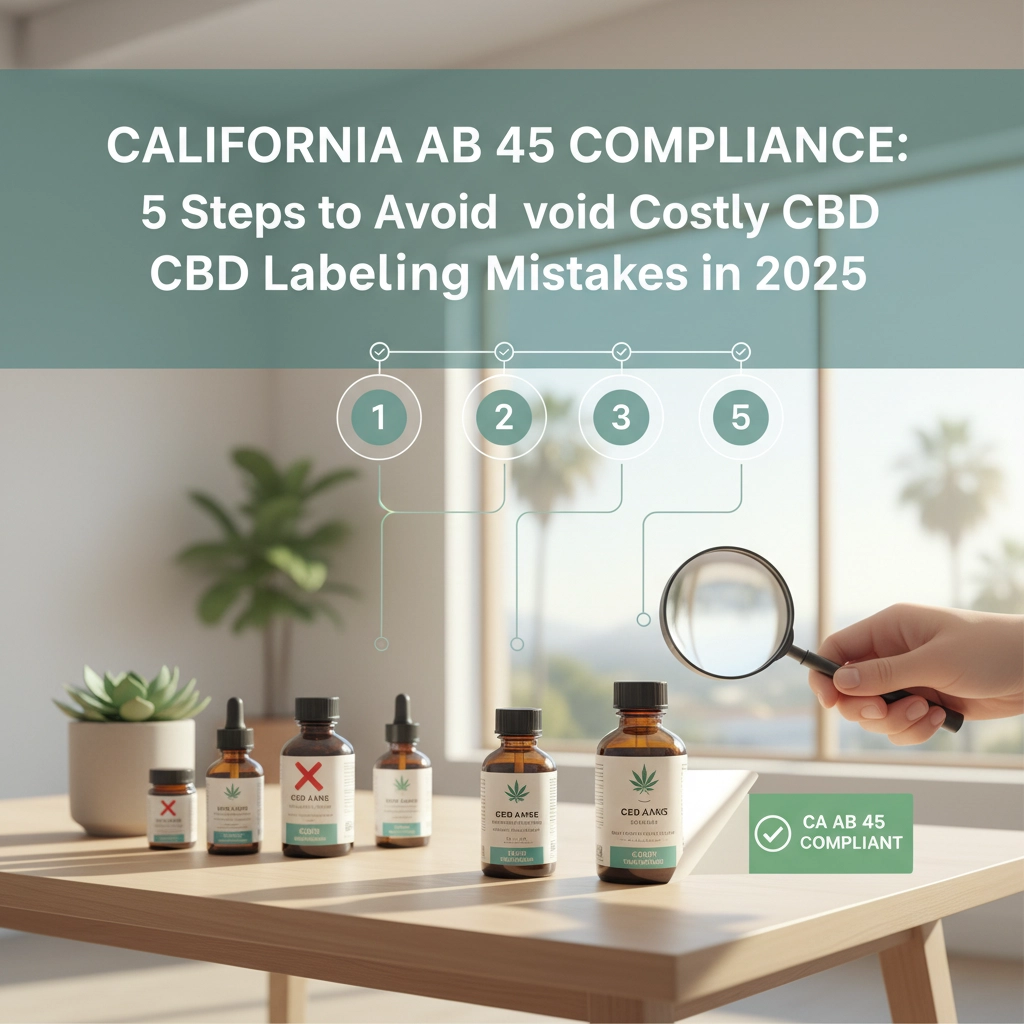
California's AB 45 has fundamentally reshaped the CBD industry landscape since its implementation. This groundbreaking legislation opened up the state's massive $2 billion hemp-derived CBD market while establishing some of the nation's strictest compliance requirements. For CBD manufacturers and retailers, understanding these regulations isn't just about following the law: it's about avoiding potentially devastating financial penalties and maintaining access to America's largest state market.
The stakes are high. Non-compliance can result in product seizures, hefty fines, and permanent market exclusion. But with the right approach, you can navigate these requirements successfully and tap into California's lucrative hemp market. Let's break down the five essential steps every CBD business needs to take to stay compliant with AB 45 in 2025.
Step 1: Complete Your Department of Public Health Registration
Before you can legally distribute any hemp products in California, you must register your manufacturing operations with the Department of Public Health (DPH). This requirement applies to all hemp product manufacturers and follows the same registration process used for food, cosmetics, and dietary supplement manufacturers.
The registration process involves submitting detailed information about your manufacturing facility, production processes, and quality control measures. You'll need to provide documentation of your facility's compliance with Good Manufacturing Practices (GMPs) and maintain current registration status to continue operating legally in California.
This isn't a one-time requirement either. Your registration must be renewed periodically, and any changes to your manufacturing operations, facility location, or product lines may require updated registration information. Failure to maintain current registration status can result in immediate enforcement action and product removal from California retail shelves.
Key Registration Requirements:
- Complete facility information and contact details
- Manufacturing process documentation
- Quality control and testing protocols
- Product category specifications
- Renewal compliance scheduling
Step 2: Implement Comprehensive Laboratory Testing Protocols
AB 45 mandates rigorous independent laboratory testing for all hemp products before they reach consumers. This testing requirement goes far beyond simple THC verification: it encompasses a comprehensive safety profile that protects both consumers and your business from liability.

All hemp products must undergo testing to verify that THC concentrations remain below the federal 0.3% threshold. However, California's definition of THC is broader than federal standards, including THCA, delta-8 THC, delta-9 THC, and delta-10 THC. This expanded definition makes California the 19th state to restrict delta-8 products, so ensure your products contain none of these prohibited cannabinoids.
The testing must also confirm the absence of dangerous contaminants including pesticides, mycotoxins, heavy metals, and residual solvents. Testing must be conducted on hemp extract in its final raw form before incorporation into finished products, and each product batch requires its own certificate of analysis.
Required Testing Parameters:
- Total THC content (including all THC variants)
- Cannabinoid profile verification
- Pesticide residue screening
- Heavy metals analysis
- Mycotoxin detection
- Residual solvent testing
- Microbiological contamination screening
The certificates of analysis from these tests become legally required documents that must be accessible to consumers through your product labeling system.
Step 3: Design Compliant Product Labels with All Required Elements
Product labeling under AB 45 requires specific mandatory elements that must appear on every hemp product sold in California. Missing or incorrect labeling information can trigger immediate enforcement action and product recalls.
Your product labels must include comprehensive manufacturer information, including your company name, complete address, and phone number. Each product must display a unique batch number that directly corresponds to the tested product batch, enabling complete traceability from retail shelf back to manufacturing records.
Cannabinoid concentration information must be clearly displayed, including total THC content and concentrations of any cannabinoids being marketed or promoted on the product. When applicable, you must also include contaminant level information as required by regulations and product expiration or best-by dates.
Essential Label Components:
- Complete manufacturer contact information
- Batch number matching tested product
- Total THC and marketed cannabinoid concentrations
- Contaminant level disclosures when required
- Expiration or best-by dates where applicable
Digital Access Requirements:
Every compliant label must feature a scannable barcode, website URL, or QR code that links directly to the certificate of analysis for that specific product batch. This digital connection between your physical product and its testing documentation is legally required and must function properly at all times.
Step 4: Include All Mandatory Warning Statements
AB 45 requires specific warning statements that must appear prominently on every hemp product label. These warnings aren't suggestions: they're legally mandated text that must appear exactly as specified in the regulations.

Your labels must include a clear statement advising that children, pregnant individuals, or those who are breastfeeding should consult with a healthcare professional before using the product. Additionally, you must include a warning that products containing cannabinoids should be kept out of reach of children.
The FDA disclaimer is also mandatory and must appear exactly as follows: "THE FDA HAS NOT EVALUATED THIS PRODUCT FOR SAFETY OR EFFICACY." This disclaimer must be prominently displayed and easily readable by consumers.
Required Warning Language:
- Healthcare professional consultation advisory for vulnerable populations
- Keep out of reach of children warning
- FDA evaluation disclaimer statement
These warnings serve important legal and safety functions, protecting both consumers and your business from liability while ensuring compliance with California's consumer protection requirements.
Step 5: Avoid Prohibited Substances and Marketing Claims
AB 45 specifically prohibits certain substances and marketing practices that can result in costly violations and immediate enforcement action. Understanding these restrictions is crucial for maintaining compliance and avoiding expensive mistakes.
California's expanded definition of THC includes substances that may be legal in other states but are prohibited in California hemp products. Delta-8 THC, delta-10 THC, and THCA are all considered prohibited forms of THC under AB 45, making California one of the most restrictive states for these compounds.
Marketing restrictions under AB 45 are equally strict. The law prohibits any labeling, advertising, or marketing that includes untrue or unsubstantiated health-related statements. All health claims must be truthful and supported by scientific evidence to avoid regulatory action.
Prohibited Substances:
- Delta-8 THC in any concentration
- Delta-10 THC in any concentration
- THCA above allowable limits
- Any total THC content exceeding 0.3%
Marketing Restrictions:
- Unsubstantiated health claims
- Medical treatment representations
- Disease cure or prevention claims
- Misleading potency statements
It's also important to remember that inhalable hemp products are specifically excluded from AB 45's permissible product categories. Vaporizers, smoking products, and other inhalable hemp items cannot be legally sold under this regulatory framework.
Staying Ahead of Evolving Requirements
The Department of Public Health retains broad authority to impose additional requirements as needed, including maximum serving sizes, active cannabinoid concentration limits per serving, and new testing or labeling requirements. This means compliance is an ongoing process, not a one-time achievement.
Successful compliance requires establishing robust documentation systems, maintaining relationships with qualified testing laboratories, and staying current with regulatory updates. Consider implementing regular compliance audits and maintaining detailed records of all testing, labeling, and manufacturing processes.
The investment in comprehensive compliance pays dividends through access to California's enormous hemp market and protection from costly enforcement actions. By following these five essential steps and maintaining vigilant compliance practices, you can successfully navigate AB 45's requirements while building a thriving hemp business in America's largest state economy.
Remember, compliance isn't just about avoiding penalties; it's about building consumer trust and establishing your brand as a reliable, professional participant in California's regulated hemp marketplace.